
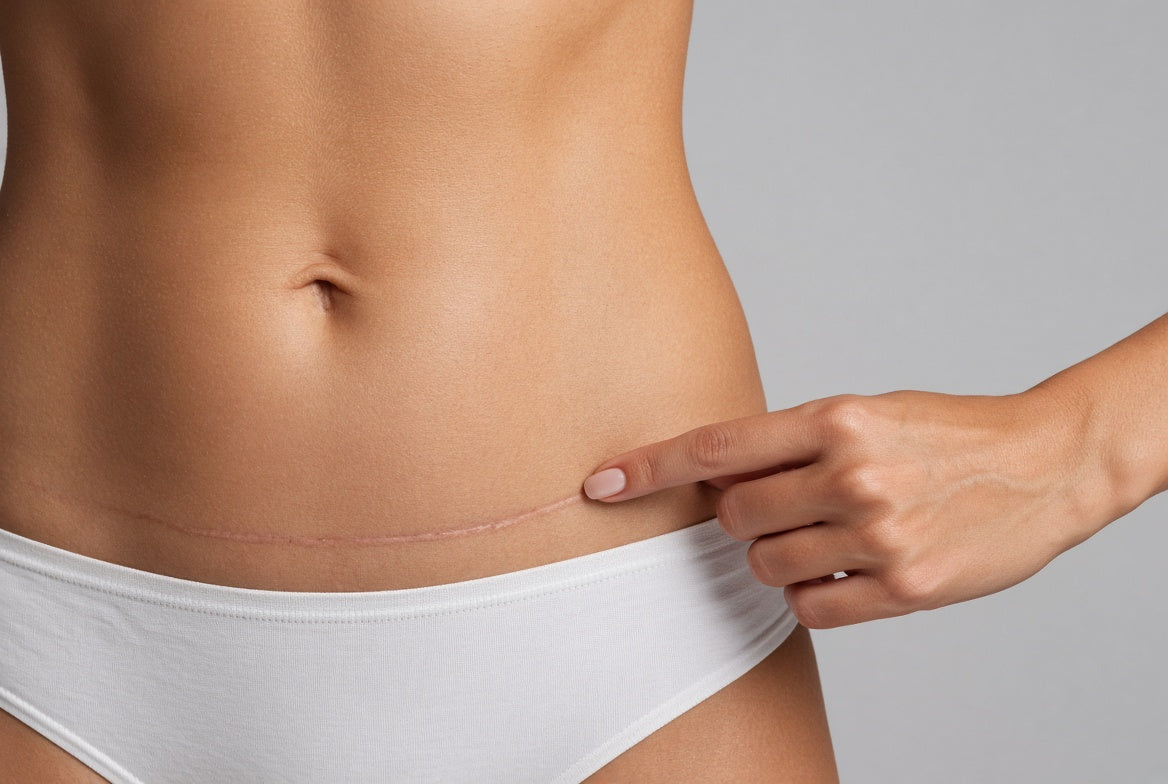
C-Section Scar Care: A Week-by-Week Recovery Journal

For mothers planning a caesarean, just out of surgery, or unsure whether what they are feeling after the operation is normal.
This article is for you if you:
- Want a realistic recovery timeline first — not just a list of scar products
- Are unsure which pain, swelling, numbness, or bleeding is common, and what needs urgent care
- Want to know when you can walk, lift an older child, drive, bathe, or start exercise
- Want to know when a C-section incision stops being a “wound” and becomes a scar you can treat
The short version:
A C-section scar comes from opening and then stitching several layers of the abdominal wall. Recovery is measured in weeks, not days. Week 1 is rest, pain control, and protecting the incision. Pain usually eases in weeks 2–3; most people only start scar care after the surface has closed. Passing the 6-week check means activity limits can loosen — it does not mean the tissue, core, and scar have finished changing. Scar gel is one step after the wound has fully closed, not the whole recovery.
What is actually healing after a C-section
Surgery cuts through skin, fat, fascia, and muscle layers, then closes them one by one. The pelvic floor has also been stretched during pregnancy and needs recovery after both vaginal birth and caesarean. So at least four tracks run at the same time:
- The incision and C-section scar
- Abdominal wall and core stability
- Pelvic floor
- Postpartum bleeding, swelling, sleep, and mood
Early “activity” is to improve circulation and lower clot risk — not to test how far you can walk or how much you can lift. Pushing too soon loads the wound, and can increase pain, the risk of opening, and later scar thickness.
Useful from hospital through the first weeks at home:
- Get out of bed with the log-roll: roll onto your side, swing both legs off the bed, then push your upper body up with your arms
- Hold the incision with a hand or pillow when you cough, sneeze, or laugh
- For about six to eight weeks, as a rule, do not lift anything heavier than the baby
First days in hospital: pain, swelling, and grogginess are common
After the anaesthetic wears off, the incision hurts. The abdomen may feel swollen, tight, or numb. You may still feel foggy. A catheter, IV, PCA pump, or oral painkillers are all routine. Staff will usually help you sit up and take short walks early to reduce clot risk and get the gut moving.
What to expect:
- The wound is covered with a dressing or tape — do not peel it off yourself
- Lochia (postpartum bleeding) continues; amount varies. Use pads, not tampons
- The gut is slow; bloating and constipation are common. Drink water, use stool softeners as advised, and avoid straining
- When holding the baby, support the abdomen with a pillow. Side-lying or football-hold feeding can take pressure off the incision
Red flags — tell staff immediately: fever; wound leaking blood or pus; sudden heavy bright-red lochia with clots; calf swelling or pain; chest pain or shortness of breath.
Week 1: you are still a surgical patient at home
Common feelings: extreme fatigue, incision pain, numbness or odd sensation nearby, and a pulling at the cut after walking. Most of this is early healing — not a signal to speed up.
Focus this week:
- Take painkillers on schedule. Do not wait until pain peaks. Better pain control makes deep breaths, coughing, and short walks easier.
- Walk short, slow distances at home to help circulation, then rest.
- Accept help with the baby, cooking, housework, and older children.
- Shower only. Let water run gently over the incision, use a mild cleanser, pat dry — do not rub.
- Keep the incision dry. No baths, hot springs, or swimming until your doctor says so (often week 3 or later).
Do not this week: lift heavy items, squat to pick things up, drive (reaction time and abdominal effort are not reliable yet), have sex, do sit-ups, ramp up exercise on your own, or apply scar gel or scar sheets. This is still a wound, not a scar you can fade.
Mood: insomnia, easy tears, and sudden anxiety can appear. Persistent low mood, inability to care for yourself or the baby, or thoughts of harming yourself need urgent medical help — do not assume it will pass on its own.
Weeks 2–3: pain eases; activity stays conservative
Pain and swelling usually start to drop. Walking feels smoother, but turning, standing from sitting, or lifting an older child can still pull. Lochia generally lessens and lightens in colour. If it suddenly returns as heavy bright red, get checked.
You can:
- Gradually lengthen short walks — stop if a walk leaves you sore all night
- Keep using the log-roll and supporting the incision when you cough
- Start very light pelvic-floor contractions if your doctor agrees (short, slow, no breath-holding)
- Eat for repair: protein, fruit and vegetables, enough fluid
Still avoid: heavy lifting, high impact, core training, and baths (unless already cleared).
When the wound becomes a scar you can treat
Judge the state of the wound, not the calendar. The surface should be closed, dry, and not leaking; stitches or tape should be off; and a clinician should agree. Most people reach this around this stage. Putting cream or sheets on an unclosed wound can irritate it and does nothing for fading.
Weeks 3–4: the incision is more stable; energy is uneven
Some people feel ready to do more; others still crash in the afternoon. Both can be normal. The incision feels firmer. Numbness or itch may start. Itch alone is not infection — but itch plus redness, heat, swelling, or discharge needs a check.
You can gradually:
- Walk longer
- Do light mobility work if cleared (e.g. pelvic tilts, heel slides)
- Use a light abdominal support belt if recommended — never so tight that breathing is restricted
Still avoid classic sit-ups, long planks, and lifting anything heavier than the baby. Driving waits until you can brake hard and turn to check the mirror without sharp abdominal pain, and until your doctor agrees.
If the incision is fully healed, scar care can start: clean, pat dry, apply a thin layer two to three times a day. The abdomen is relatively flat, so if a clinician suggests a silicone sheet, wait until the gel is fully dry first. Do not sheet over wet product. Face and joints follow different logic; a C-section scar sits on the abdominal wall, so gel first, then sheet if needed, is usually more practical.
Weeks 4–6: preparing for the six-week check
Pain drops further. Everyday walking is easier, but night feeds or holding the baby for a long time can still make the incision feel tight and tired. Lochia should be nearly finished; remaining heavy bleeding needs to be reported.
The six-week visit usually reviews: incision healing, uterine involution, lochia, blood pressure, mood, and whether more structured postnatal exercise, driving, and sex can start. Passing the check does not mean the abdominal muscles, pelvic floor, and C-section scar have finished recovering.
Common misunderstandings:
- “The doctor said I can exercise” is not the same as gym-style ab work
- “The scar no longer weeps” is not the same as “the scar has settled”
- “It hurts less” is not permission to carry shopping bags or haul a toddler up stairs
In the first two to four weeks of scar care, itch and tightness often improve before colour. Even after you start a product, keep protecting the abdomen and avoid repeated pulling.
After week 6: tissue remodelling is only entering the next phase
Over the following months, sensitivity, scar colour, and how stable the core feels under load will keep changing. Some scars soften and fade; some look redder or itchier when you are tired or around a period. That is not failed recovery.
A safer order once your doctor has cleared you:
- Breathing and gentle core activation (not sit-ups)
- Pelvic floor work combined with walking
- Low-impact strength
- Then consider higher intensity or load
Classic sit-ups, double-leg lifts, running, or skipping wait until a professional has assessed diastasis and the pelvic floor. Squeezing the abdominal wall too early can make a C-section scar redder and thicker, and can worsen pelvic-floor symptoms.
Daily load still counts: overnight feeding, always carrying the baby on one side, and lifting a toddler from the floor with poor form can stress the incision as much as a workout.
Where the C-section scar sits in the whole timeline
- Wound phase: clean, dry, watch for infection. No scar products.
- After closure: usually from weeks 2–3, and only with clinical agreement, start scar care and continue for three to six months.
- After week 6: activity can increase step by step. The scar is still changing — do not stop care too early.
On a flat abdomen you can use a silicone sheet, a fast-dry gel alone, or gel first then a sheet. Silicone’s value is occlusion and moisture. If the scar is red and itchy, you sweat a lot in summer, or sheets lift at the edges, a thin mechanism-based gel is often easier to keep using.
Herbap Matrix Scar Repair Gel (康疤適) is a non-silicone, fast-drying formula. The surface is usually dry to the touch in about three to five minutes, so it suits a healed C-section scar before dressing or before applying a sheet. It is not the main character of recovery, must not go on an unclosed wound, and does not replace medical care for infection or keloid.
Product details: Herbap Matrix Scar Repair Gel.
When to seek care (do not “wait another week”)
- Incision that is red, hot, swollen, painful, leaking, smelly, or opening, or fever
- Sudden heavy bright-red lochia, dizziness, or palpitations
- Calf swelling or pain, chest pain, shortness of breath
- Scar growing beyond the original incision and still enlarging
- Pain or itch that disrupts sleep, holding the baby, or walking
- Persistent low mood, or inability to care for yourself or the baby
FAQ
Can I put gel on a C-section scar in week 1?
Usually no. Wait until the surface is closed, dry, and not leaking, and a clinician agrees.
Do numbness or itch mean infection?
Numbness or mild itch alone can be part of healing. Combined with redness, heat, swelling, discharge, odour, or fever, get checked.
When can I bathe or swim?
When your doctor approves — often week 3 or later. Do not soak an unstable incision.
When can I drive or have sex?
Usually once you can brake safely, the incision has healed, lochia has lessened, and you have clearance around the six-week visit. It varies.
Does passing the six-week check mean recovery is finished?
No. That visit loosens activity limits. Core, pelvic floor, and the C-section scar still change for months.
Will sit-ups make the belly and scar look better faster?
Not early on. Premature core loading increases tension on the incision and is unhelpful for both the scar and the pelvic floor.
Share:
When Should You Use Scar Gel? How to Choose Silicone vs Non-Silicone
How Long Does a Surgical Scar Take to Fade? Redness and Raised Texture Do Not Improve Together