
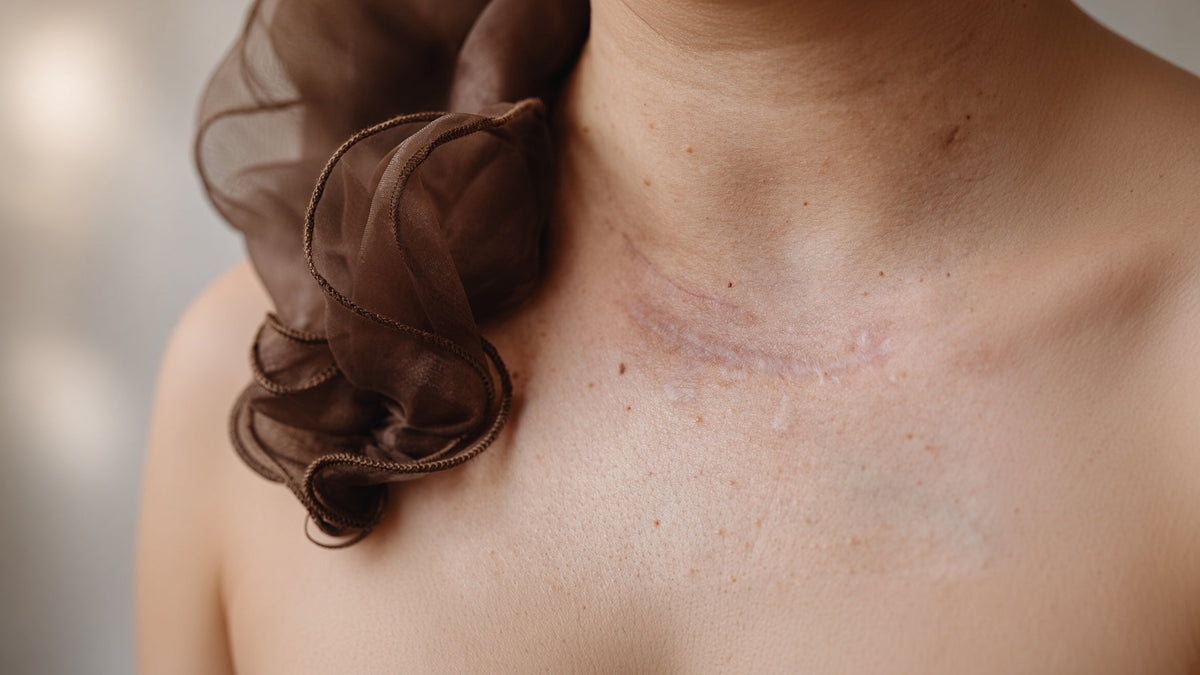
How Long Does a Surgical Scar Take to Fade? Redness and Raised Texture Do Not Improve Together

For people whose scar is still red or raised after stitch removal, or who have used a scar product for three to four weeks with little colour change and worry it will stay this way forever.
This article is for you if you:
- Still have a red, raised surgical scar after stitches come out, and fear it will stay
- Have used scar gel for several weeks with almost no colour change, and assume the product does nothing
- Want to know which improves first — the raised part or the red mark
- Want a realistic fade timeline, not “lighter in two weeks”
Short answer:
A closed wound is not a finished scar. Surgical scar repair continues for months. The usual order is: itch and tightness change first, then redness and firmness start to ease. Flattening usually shows before colour clearly fades. “No scar at all” is not a reasonable target. Most surgical scars should be judged over three to six months, not two weeks.
Why redness and raised texture do not improve together
After surgery, “red” and “raised” are not the same problem.
- Red marks / a red scar: more about dilated vessels and pigment. Sun stretches the redness out, so colour often lags behind how the scar feels.
- Raised scar: more about collagen and matrix deposition. Incision tension, repeated scratching, and site (joint, chest, abdomen) matter more.
So: redness that has not faded does not mean the scar is still climbing. A scar that feels softer does not mean the colour is already good. Judging “is this working?” by both in the same week is the fastest way to quit early.
Surgical scar fade time: a common order
Timing varies by person, incision length, and site. Face, abdomen, joints, and C-section scars carry different tension, so they do not move on the same clock. The table below is a reference for most new surgical scars — not a guarantee.
| Stage | Timing | What you usually see first | Common misconception |
|---|---|---|---|
| Just closed | About weeks 2–3 after surgery | Topicals can start once a clinician agrees | Do not apply before closure |
| Early | Weeks 2–4 | Itch and tightness often change first | Colour not faded ≠ failure |
| Mid | Months 1–3 | Redness and firmness may start to ease | This is when people quit |
| Later | Months 3–6 | Other people notice flatter, lighter | Stopping at first fade lets redness rebound |
| After | Months 6–12 | Remodelling continues | Still red or thickening → extend care or see a doctor |
Remember one line: fade time is measured in months. Two to four weeks is usually only enough to judge whether itch and tightness are settling — not enough to judge colour.
Which scars have more room to improve — and which have less
Relatively more room:
- New post-surgical scars that are still red and itchy
- Scars within two years that are not fully mature
- Lower-tension sites you can treat consistently
Relatively less room:
- Mature old scars that are pale and hard
- High-tension joint scars that keep being pulled
- Keloids (growing beyond the wound)
Hypertrophic scars stay roughly within the original wound. Keloids grow outward past the incision. Do not treat the latter by swapping gels — see a doctor. Acne marks work differently; do not force this surgical-scar timeline onto them.
How to judge “is it working” without only watching colour
Ask these three first:
- Has the itch eased?
- Does it feel less hard?
- Have you stopped scratching it open?
Then look at colour and height. If surgical scar care has left you with “still a bit red,” but less itch and less firmness, you are usually still on the path — not an instant fail.
Only consider switching category after several consistent weeks.
What you cannot speed up
- A thicker layer will not make a surgical scar fade faster
- Dropping sun protection lets redness rebound
- Scratching itch is a second injury — more red, more raised
These are not product slogans. They are what many people are doing when they decide “this isn’t working.”
Where Herbap Matrix fits
Herbap Matrix Scar Repair Gel suits new surgical scars that have closed, are still red and itchy, and that you plan to treat for months. The formula is built around flavanol glycoside small molecules extracted from ferns. It does not guarantee a fade date and does not treat keloids. When to start, and gel vs sheet, are in the two articles above.
When to see a doctor
- Scar growing outward beyond the wound
- Redness, heat, swelling, pain, or ongoing leaking
- Pain or itch that disrupts sleep or joint movement
Full list: Post-Surgical Scar Care: Three Things Still Needed After the Wound Has Healed.
FAQ
Still red after a month — did it fail?
Not necessarily. Redness and firmness more often start to ease between months 1 and 3. If itch and hardness have not changed at all, or the scar keeps thickening, then consider a different approach or a doctor.
Will a raised scar flatten on its own?
Some new scars soften and sit lower as they remodel. High-tension sites and thickening scars do not “finish themselves.” Do not wait a year to start care.
Is the timeline the same for face and abdomen?
No. Facial skin is thinner and more visible, and needs sun protection more often. The abdomen — especially after a C-section — has more tension and daily pull, so fade time can be longer.
Is there still a chance for an old scar within two years?
Scars within two years can still improve, especially if they are still red and itchy. Fully mature, pale, hard old scars have less room — keep expectations lower.
Does a C-section need longer?
Usually yes. Holding a baby, sitting up, and coughing all pull the incision. Abdominal tension is higher than many small cuts. Start the clock at three to six months. Passing the six-week check is not the same as finished fading.
The goal is flatter, lighter, less noticeable — not as if there was never a wound. When you enquire, note how many weeks post-op you are, and which bothers you most: red, raised, or itchy.
Share:
C-Section Scar Care: A Week-by-Week Recovery Journal